Thursday, October 23, 2014

The Ethics of Seed Collection

Nice, unharvested seeds.
I am passionate about native plants. I’m quite serious- it has been years since I intentionally introduced a non-native plant to my yard (other than vegetables, of course). Naturally, I jumped at the chance to get involved when my work gave me the ‘go-ahead’ to help with native seed sourcing. However, seed collection is not so simple as “find, harvest, propagate”. Many native plants have suffered population declines from over-collection, so it is important to take steps to ensure an ethical harvest.

Ginseng, orchids, carnivorous plants, echinacea, black cohosh, golden seal, and galax have all suffered from over collection. What do these plants have in common? They are the medicinal, the rare, and the weird. This damage is nothing to be sniffed at. Galax is harvested for its value in floral arrangements. The majority of galax stands along the Blue Ridge Parkway in the Southern Appalachians were targeted by poachers in 2012 [2].  Even worse, plants like ginseng, echinacea, and black cohosh are entirely destroyed by harvest, as the root is the part of the plant consumed. Others, like orchids and carnivorous plants, are delicate and often do not survive transplanting in their new environs anyway.

Someone may have beat me to it.
Or was it the wind?
Declines in medicinal plants have been well studied. Ginseng is a famous example. Recently, a ranking criterion was created to estimate the vulnerability of a plant to over collection. Traits on this list included: life history (i.e., how long does it take to reach maturity, what is its reproductive rate), effect of harvest (is the plant killed when harvested), population size, habitat, and demand [1]. To avoid over collecting, one should limit the amount of seed collected from a population, and not collect from the same site year after year. There isn’t a consensus on exactly how much seed you can collect from a population without causing harm. Some sources say no more than a third, others say 10%, and others yet say 5% per year over 10 years. I am sure that the exact details of a ‘safe collection rate’ vary by species, population size, and location. Generally agreed upon exceptions to these guidelines are in the case of plant salvage—where plants are removed from a site prior to its destruction or development. In this case, 100% harvest is acceptable.

In addition to calibrating your harvest level against the possibility of causing real damage to the landscape, one must consider legality. Obviously it is illegal to collect protected species. It is also illegal to collect in most State and National Parks. Often one can collect on Forest Service or BLM land, but this typically comes with restrictions and requires the purchase of a permit for a small fee. Collecting on private land is OK with permission as long as the target plant is not protected. Roadsides are something of a toss-up—most seed collectors (including myself) believe road sides to be fair game. However, if someone requested that I stop collecting from along their property, I certainly would.

Restored crop-field prairie
Somehow, while juggling all these factors, I have managed to harvest from two sites. One was a roadway in Denton County.  The other was a private prairie north of Temple. My harvest protocol in Denton was pretty clear-cut. Unless someone stopped me, I would be able to collect seed. Additionally, the roadsides had been mowed and most of the seed heads shattered, so I wasn’t too worried about over collecting. I probably couldn’t have collected more than 5% of the seed produced even if that had been my intent.

The second site, the private prairie, was a little fuzzier. While I made sure to get permission prior to collection, once I arrived on site it became clear to me that someone had already harvested some seeds from the target species earlier in the year. A few stalks had legible cut marks on them, while others did not. So the question became: how much could I take sustainably? How much seed had there been before the previous collector came?

After doing some looking around I decided that the original collectors had not taken much, and had collected from a central location along a mown path. Most of the bare stalks outside that area had a few seeds still hanging off them, suggesting that they had been shattered and scattered by non-human means. The plants that still held their seed were lower and had not been so exposed to the wind. I fretted some, and I never did settle on an exact amount that it would be OK to collect, but I did the best I could. I am comforted that, someday, the descendants of this foundation seed will be used for prairie restoration and will support many pollinators and other wildlife.

------


1.     Castle, L. M., Leopold, S., Craft, R., & Kindscher, K. (2014). Ranking Tool Created for Medicinal Plants at Risk of Being Overharvested in the Wild. Ethnobiology Letters, 5, 77-88.


3.      

Sunday, October 19, 2014

Halloween in the Cross Timbers: The Legend of Goatman's Bridge

Graffiti on Old Alton Bridge

To me, halloween is an excuse to indulge in creepy ghost stories and, frankly, morbid curiosity.  For this reason I took my dog on a special excursion up to the eastern Cross Timbers in Denton County. We were going to see the Goatman's Bridge. 


Colby ain't afraid of no goats
Old Alton Bridge is the setting for one of the more widely circulated local ghost stories. Built in 1884, this single lane truss bridge was still in automotive use up to 2001, when it was replaced by a steel and concrete construction that straightened the sharp curve in the road crossing Hickory Creek [1]. Evidently, up until the bridge was replaced, you'd essentially honk and pray for attentive oncoming traffic while roaring across in your car. Now it has been retired from heavy traffic and instead serves as the link between the Pilot Knoll and Elm Fork horse and foot paths. 

There are conflicting reports of the origin of this bridge's specter. Most versions of the story say that a successful goatherd named Oscar Washburn was lynched from the bridge by the Klan in 1938. The klansmen found the noose empty after throwing Oscar over the edge. Enraged by his presumed escape, they crossed the bridge and slaughtered the man's wife and children. Legend has it that if you cross the bridge after dark you'll see the glowing red eyes of a demonic satyr menacing you from the other side. The Goatman is hunting the klansmen who murdered his family, and those descended from the klansmen are cursed to be hunted unto death.

Fortunately, there seem to be no historic records of an Oscar Washburn or of a lynching from the bridge. While there was racially motivated violence in the surrounding area at the time, Oscar Washburn and the Goatman seem to be nothing but a cipher standing in for the guilt felt for all those unjustly persecuted during the racial tensions of the 30s [2].

Another entity also said to reside in the haunted forest resembles the Mexican legend of "La Llorona", the weeping woman who haunts rivers, steals lost children (especially those that disobey their parents!), and marks for death all who hear her. As is so often the case, ruffians attracted by the dark stories cause more trouble than any ill-tempered apparition. The area near the bridge is littered with empty shotgun shells, blown out signs, and broken glass. The local Master Naturalist group has a standing clean-up date on November 1st, putting the park back in order after the unauthorized Halloween night festivities. 


Small red arrow pointing to sneaky clump of sericea
established along the trial. Grr. 
I did encounter one menacing presence along the trail: Lespedeza cuneata, aka sericea lespedeza, scourge of rangelands and forests throughout much of North America. This invasive, perennial legume is not supposed to occur in Denton County (yet), (see comments section) but there it was, making in-roads along the horse trail. This (ob)noxious weed is a prolific seeder and can rapidly crowd out every other plant in a stand. Single ramets (stems) can produce 1,500 seeds per year, and cultivated stands can yield up to 300 million seeds per acre [3]. One is truly sickened when considering the person-hours and herbicides dedicated to the control of this aggressive species. 

Today the park winds through dry meadows surrounded by scrubby post-oak, cedar elm, hickory, and hackberry forests.  It's early autumn in the eastern Cross Timbers, and heath aster, goldenrod, sneezeweed, eryngo, partridge pea, broomweed, and agalinis still bloom. Mothers were taking halloween-themed pictures of their small children on the bridge. It's a little macabre when  one considers that the bridge is famous for an apocryphal lynching. 


I have low expectations for this buckeye's longevity
Despite this, Colby and I had an altogether pleasant walk along this historic path. While we didn't see any satyrs or weeping women, we did see skippers, sulfurs, buckeyes, a red admiral, and tardy monarchs that were flitting around the meadows and low canopy.  Mercifully (?), Colby only cared to snap her jaws at the skippers and sulfurs that were fully capable of evading her, showing no interest in a largely incapacitated buckeye we found resting on the trail. I suppose it wouldn't have been "sporting" to pursue already downed prey. We both have an interest in bugs, after a fashion.

I only walked the first few miles of Elm Fork trail. There are many more miles and trails to explore [4]. Perhaps someday I shall come back to view more of these well-used paths-- during the daytime, of course.


Hickory Creek and Old Alton Bridge


Virginia creeper begins to senesce 


----
1. http://bridgehunter.com/tx/denton/old-alton/
2. http://wedentondoit.com/blog/2013/10/18/back-in-the-day-goatmans-bridge
3. http://www.fs.fed.us/database/feis/plants/forb/lescun/all.html#SeedProduction
4. https://cityofcorinth.com/DocumentCenter/View/2243

Saturday, October 11, 2014

The Singular Flint Hills


Ironweed does well first year after a burn in the Tallgrass Prairie Preserve
I have been feeling the absence of a major camping trip this summer, so I’ve been stealing the odd night sleeping out when I can. A few weeks ago I was in the Kansas Flint Hills for work, and I took my tent. I camped in my rancher-host’s backyard instead of crashing on a couch or in a hotel. This may present a funny image to those of us in the suburbs, perhaps conjuring a childhood sleep-over with friends and visits from mom and dad with treats and bedtime stories. However, when you’re in the Flint Hills and your host owns a mile in every direction, camping is a little more enticing.

House under the stars
The coyotes seemed somewhat muted by the new moon. The first morning they howled at the sunrise. The second night, after violent passing storms, they slept late and only started yodeling to each other around 8:30 am. I wonder where they hunker down, and if they can stay dry, during the storms on the Great Plains. My old tent did fine- the seams do need to be re-taped, but any water that seeped in pooled up like a moat around the edges. I stayed high and dry on my closed-cell foam sleeping pad.

The dark moon made for an excellent showing of the Milky Way. It looked like a band of thin, high fog across the sky. I was inspired to attempt nighttime photography for the first time. I had guessed that the stars would be spectacular in Kansas, so I brought my tripod and remote shutter control. This won’t be last time I try to capture a starry night-- two state parks and one national park in Texas (Copper Breaks, Enchanted Rock State Natural Area, and Big Bend National Park) have been designated “Dark Sky Parks” by the International Dark Sky Association. Both state parks are less than a four-hour drive from Fort Worth. For reference, there are only 14 certified Dark Sky Parks in the entire United States.

Stars over Kansas
I was in Kansas to view some sites where cattle grazing had been well balanced with biodiversity conservation. To this end, I visited the Tallgrass Prairie Preserve and a private ranch in the Flint Hills. The Flint Hills are an amazing pocket of semi-natural grassland in an otherwise cropped region. The ‘flinty’, fossiliferous limestone accretions, from which the Hills get their name, made these rolling plains simply too much effort to farm. Unlike much of the surrounding region, the Flint Hills never submitted to the moldboard plow. Grazing rules the economy here.


Fossil I found on my host's ranch
Most local ranchers burn their pastures every spring to freshen the grass for their cattle. The historic fire regime was probably closer to 3 to 6 years, but it’s difficult to say if the accelerated fire regime is good or bad on the balance. Annual burning can lead to erosion, homogeneity, and ‘pedestalling’, where soil around bunch grasses washes away, leaving the bunches on an elevated base (or ‘pedestal’). On the other hand, annual burning has allowed the Flint Hills to largely retain its open, blue-sky character in the face of widespread woody shrub encroachment. Personally, because so much of the tallgrass prairie has succumbed to woody encroachment, I think I may prefer annual burning to no burning at all, if those are the only choices. Both can be hard on a landscape, but at least annual burning keeps some land open.
Wind in the goldenrod

Overall, the Flint Hills look good. The grassy, rolling hills reminded me of a gigantic alpine meadow—which is logical, I suppose, as it is a gigantic (sub) alpine meadow. ‘Sub’ in the sense of ‘lower than’. The Tallgrass Prairie Preserve even has the novelty of bison. While it is arguably ‘understocked’ in that there are only 30 bison grazing a 1,100 acre pasture (TGPP has ~11,000 acres total), it is lovely. I’ve heard rumors that they aim to build their herd. Because they desire genetically ‘pure’ bison- bison that are uncontaminated by the cattle genome- they have had some trouble getting their hands on these high-demand livestock. Or should they be called wildlife? I suppose that’s a question for another time. 

Skeptical bison look on from the bluff

Tuesday, October 7, 2014

Peak Monarch 2014

Monarch sharing a pitcher sage plant with a bumble bee
This week we're hitting "peak monarch" in Fort Worth. According to Monarch Watch estimates, tomorrow is the midpoint of the height of monarch butterfly abundance for Fort Worth's fall migration [1]. I'd actually noticed the up swell in the population over the past week, especially after Thursday's passing storm. Every time I looked up I'd see at least one monarch flapping hard to the south, sometimes as many as three. It makes sense to me that they would follow the fronts. They do, after all, ride the wind. The last of this year's monarchs should finish passing through by November.

Monarch Fall Migration, from USFS pollinator site [2]
Texas is the funnel through which many migrating monarchs pass on the way to their Mexican wintering grounds. While most people are aware that monarchs migrate south to avoid our North American winters, I still find the flip side of this equation shocking: they must recolonize their entire range every year. Instead of overwintering in the litter and duff, brave monarch parents must fly the length of a continent.

Unlike the Methuselah-monarchs bent on the southern horizon in the fall, the spring migration requires multiple lifetimes [2]. They drift northward over 3 or 4 generations.  It appears to be these shorter lived summer monarchs that are the sink of the decreasing monarch brood. For years people blamed declining populations on habitat loss in the monarch wintering roosts in Mexican forests. Recent studies suggest that it is actually the Midwest's ultra-efficient weed control in the summer breeding grounds that is at the root of the decline. Monarchs simply can't find enough milkweed on which to lay their eggs.

Asclepias asperula, antelope horns/spider milkweed
In addition to being the last stop on their way south, Texas is their first stop on the way north to summer pastures. Increasing the abundance of milkweeds in Texas could be hugely beneficial to these amazing creatures. There are over 30 species of milkweed which can be found in Texas [5]. You can find range maps of the milkweeds (Asclepias spp) at the BONAP (The Biota of North America Program North American Vascular Flora) website [3]. In my neighborhood, I tend to see Asclepias asperula, A. viridiflora, and A. viridis. All three species are documented larval hosts to monarchs. 'Documented larval host' means monarch caterpillars have been officially observed and recorded feeding on these plants [4, see appendix for list of milkweeds]. Milkweeds you may find in north central Texas include [3]:

A. amplexicaulis*
A. arenaria
A. asperula*
A. engelmanniana
A.incarnata*
A. latifolia
A. linearis (likely endemic to Texas)
A. longifolia*
A. obovata
A. oenotheroides*
A. perennis*
A. stenophylla
A. subverticillata*
A. texana (endemic to Texas)
A. tomentosa*
A. tuberosa*
A. variegata*
A. verticillata*
A. viridiflora*
A. viridis*

* denotes documented larval host to monarch caterpillars [4]

It is possible that some of the milkweeds that have not been documented as larval host plants have successfully nourished monarch brood. Some, like the Texas endemic Asclepias texana, are relatively uncommon and are less likely to be observed, period. I'm a bit of a plant collector so I'm going to try to get my hands on some native milkweed seed to sow this winter. In the spring, after receiving the cold/moist stratification they require in my fallow garden, these seeds should emerge and start my monarch buffet. Eventually my plants will provide high-quality nectar to monarch butterflies on their way north, and leafy lunches to little monarch caterpillars beefing up for their transformation and long journey.

As an FYI to any North Texas readers: this week is the Fort Worth Botanic Garden's fall plant sale. I have not confirmed that they will be selling milkweed, but considering their focus on native plants and insects I think it is fairly likely. The plant sale starts the evening of Friday, October 9th and goes through October 11th. You can find more information here.

Good bye monarchs, at least until March next year!

---------
1. http://www.monarchwatch.org/tagmig/peak.html
2. http://www.fs.fed.us/wildflowers/pollinators/Monarch_Butterfly/migration/index.shtml
3. http://bonap.net/NAPA/TaxonMaps/Genus/County/Asclepias
4. http://www.xerces.org/milkweeds-a-conservation-practitioners-guide/
5. http://npsot.org/wp/story/2012/2235/

Sunday, September 28, 2014

Revisiting Tandy Hills


View of downtown Fort Worth from Tandy Hills
Tarrant County, TX includes parts of both the Grand Prairie and the Western Cross Timbers ecoregions.  Thin clay soil over caliche supports prairies, while deeper, sandy soils can host scrubby oak-juniper forests. The difference is all in the water capacity. A tree can make a go of it if it spreads its root system in the sand, but the shallow clays just can't hold enough water. In this way, the soils structure the plant communities irrespective of their shared precipitation regime.

After returning to Tandy Hills last weekend, I looked at soil maps of Tarrant County to try and understand why it has stayed so open on the ridge top. Nothing struck me as different at the map resolution I could find- there were no unusual soil inclusions marking Tandy as different from the surrounding area. I do know that in savannas, hill tops are often left as prairie because their thinner soils hold less water. The main patch of prairie in Tandy is on top of the hill. Perhaps this is why.

It may be almost October, but the highs are still in the low 90s. The rain has returned, and a number of plants are putting on a second flush of flowers. Prickly pear fruits are bright red and ripe, reminding me of their alternate common name "cactus apple". Eryngo, snow-on-the-prairie, and false foxglove are all hitting their peak bloom. Others, like basket flower and white compass plant, have long since set their seed heads for the year.

Spiky, sticky white compass plant seed heads. 
Silphiums (i.e., compass plant, rosin weed etc) are unusual among composite flowers. Composite flowers, like sunflowers and asters, are distinguished by being composed of multiple smaller flowers bound together in a larger flower head. In a sunflower, the flowers that produce sunflower seeds are the 'disc' flowers, while the 'ray' flowers around the edges do not. This is the common arrangement for composites. However, silphiums set seeds from the 'rays'. If you harvest a seed head and break it apart in your hand it resembles an artichoke.

False foxglove, Agalinis spp. 
I also learned a new plant: false foxglove. False foxglove has flowers like a penstemon (or foxglove), but set along thin branching stalks with small leaves. I didn't notice the fringe of hairs along the edges of the petals until I looked at my pictures later. This widely distributed annual flower is in the Orobanchaceae family, and like other members of this family it is 'hemiparasitic' on the roots of other plants-- that is, it taps the roots of other plants to satisfy some of its nutritional needs. Perhaps this nutrient piracy could explain why the leaves seemed so undersized.

Eryngo, Eryngium leavenworthii, with small caterpillar
Eryngo is another flower whose details became more evident when I viewed the pictures later. I love the differences in tone between the indigo pollen and the royal purple flower. At first I mistook the late-season caterpillar for a bit of chaff or leaf matter.

Indeed, the insect life is still humming in this little prairie. On my way out, I noticed an oddly posed praying mantis near a clump of white fluff on a blazing star bloom. It didn't look like her egg sac to me- if anything, it looked like a small cocoon. I could be mistaken. I decided not to disturb her or the white mass and instead let them continue their preparations for the end of the growing season in peace.

Praying mantis, unIDd fluff, on blazing star


Monday, September 22, 2014

Bison yarn and royal purple

TNC's Niobrara herd. I helped sort them a couple times last year.
Every winter I knit socks, mittens and hats for my family, and somehow the process is even more enjoyable if I’m working with lovely materials.  I’m a sucker for beautiful yarns. This weekend I visited the Blackland Prairie Artisan and Fibre Faire up in Denison, Texas in search of new supplies. I arrived at Loy Park (home of the Grayson Frontier Village, behind a fence topped with a triple strand of barbed wire). There was also a lake, a bridge leading into the woods, and what looked like an old brick furnace. The surrounding land was mainly grazed. I found it picturesque.

The 'faire' itself was held in a large open shed with two horseshoe-shaped lines of booths on the interior facing the main entrance. It didn’t look that big, but it took me an hour to make a full circuit. When you fondle yarn and make small talk with half the craftspeople, I suppose the minutes add up. You could buy raw wool, yarns, baskets and other handicrafts. There were also artisans demoing the use of drop spindles, looms, and a great wheel.

One of my favorite displays was the natural yarn dying station. They had bright mustard orange from Bois d’Arc wood chips (also called Osage Orange), a fuchsia from prickly pear cochineal, and a natural indigo. The cochineal dye was most exciting to me. Similar to the ancient Greek ‘Tyrian’ or ‘Royal’ purple, it is derived from a crushed invertebrate. Instead of Tyrian purple’s Greek sea snail, cochineal originates in the body of minute scale insects living on the surface of Opuntia cacti. It has a Mayan and Aztec pedigree.

I also had the chance to reminisce about my days working with bison. I was delighted to discover a trailer and a booth for the Buffalo Wool Company, based out of small town just a little south of Fort Worth. I could not believe it was possible to buy bison yarn! Naturally, I bought myself a nice sized skein for a special project (TBD). I just love bison. I can’t help it. I'd argue they’re North America’s signature megafauna.

Buffalo Wool Company has moved their 35-bison herd to Goodnight, Texas since the metroplex has encroached upon the company’s original holdings in recent years. The company’s founder actually took some satisfaction in moving the herd. As some of you may know, the Texas legend Charlie Goodnight (for whom the town is named) is largely responsible for preventing the extinction of the southern bison. Lore has it that Charlie’s wife noticed the herd was much diminished and prevailed upon him to save the last few hundred. The descendants of those individuals now make up the core of the Caprock Canyons herd. For the Buffalo Wool Company, bringing their bison back to Goodnight was almost like coming an emotional full circle.
 
The Niobrara herd during fall round-up

Surprisingly, 35 bison are only good for about two skeins of yarn. Well, it’s surprising until you realize what one must go through to harvest the down from a bison. These are wild animals and they aren’t going to sit patiently while you give them a haircut. Fortunately for the wool gatherers, they aren’t going to sit still while you jab them in the rump with a vaccination needle either. Bison can carry brucellosis, which causes spontaneous abortion in cattle, and for this and other reasons they typically receive annual vaccinations. You have to round them up, get them in the corral, and then run them through a squeeze chute. You aim to keep them in the shoot for six seconds or less (to avoid excess strain on the beasts), and it is during these six seconds in the chute that you can shear a little strip of wool for the yarn. Apparently, they often come out with just a small racing stripe removed.

Other ways to harvest the wool include taking the brushes from street cleaners and setting them up vertically. The bison, eager to be rid of their winter coats, rub off their old hair on these convenient scratching posts. In addition to taking bits and bobs of fuzz from other bison ranchers, Buffalo Wool Company collects wool from the leathers discarded after a bison meat harvest. In this way, they are able to produce enough yarn to sell. I ended up buying a skein of a 50:50 bison/merino blend, though I was sorely tempted by the bison/silk. My yarn appears undyed. Perhaps I’ll go collect some cochineal to create my own all-American fiber. 


Saturday, September 13, 2014

Seasons change (in remembrance of seasons past…)

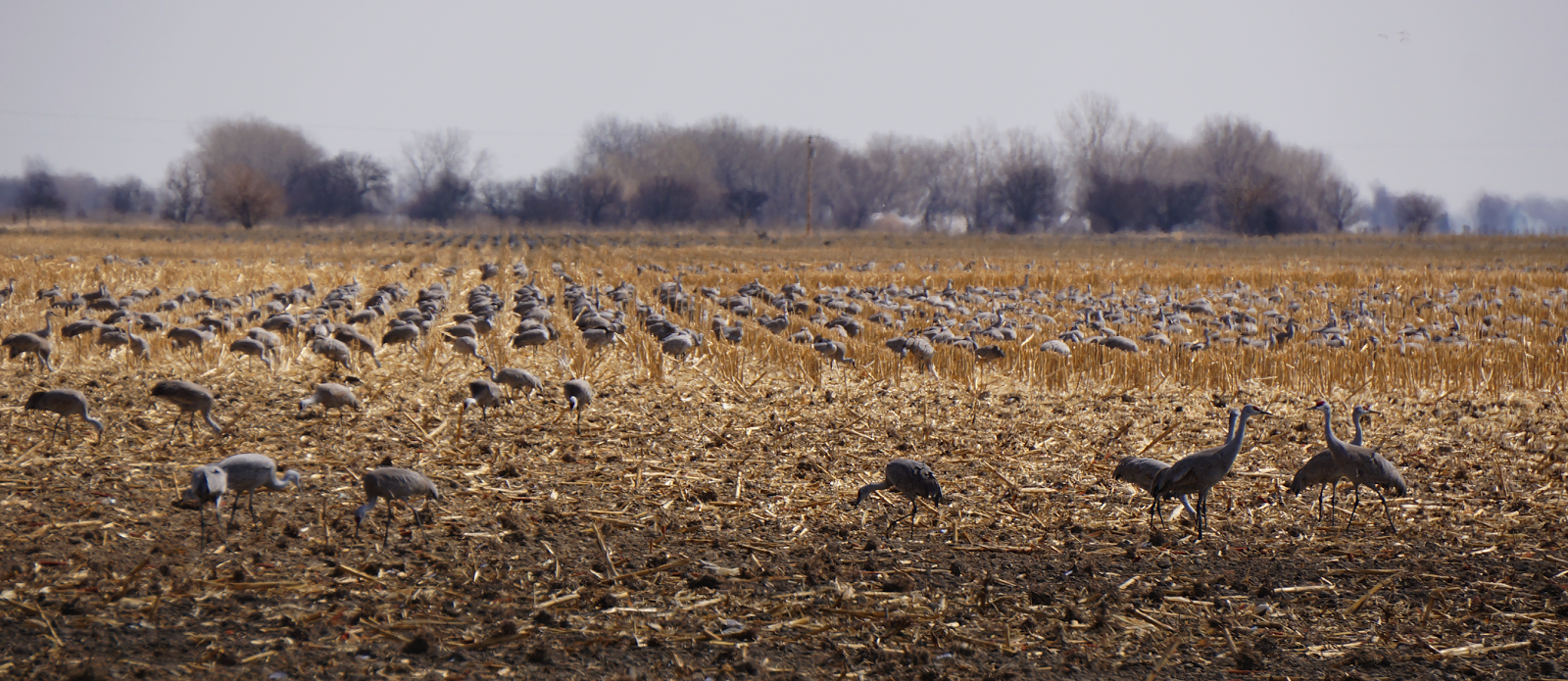
I liked how the cranes would arrange themselves in neat lines along the furrows

The seasons are shifting here in Texas. A cold front brought 3 days of drizzly overcast and highs in the low 70s. Considering that only last week we were topping out in the low 100s, this is quite a change. I was not ready for such an abrupt transition. Frankly, I was expecting to fight 90+ degree heat well into October. I may yet.

The birds know what's coming, though. We are in the peak of the southern hummingbird migration here in Fort Worth. I hung a feeder a few days ago, and the transient and ferociously hungry hummers found it just hours after it was filled.  I live in downtown Fort Worth and I can only imagine what the populations are like in less urban areas. 

I love the awkward way cranes land

On a related note, I was flipping through pictures stored on my camera this morning, and I re-discovered a series of images I took capturing this year's other major seasonal transition: instead of the casual moving-on of birds migrating to warmer climes for the winter, I snapped shots of sandhill cranes hurriedly re-fueling on the way to their summer breeding grounds.

Some of you may be aware that I moved to Texas from the state of Nebraska.  I spent most of my time on the Platte River in central Nebraska, the midway point and major pit-stop for the sandhill crane migration. With the conversion of much of the prairie to corn, sandhill cranes have responded to the shift in available calories and are now 95% corn-fed.

I took these pictures on a late March day in Nebraska. It was warm enough that I didn't need a heavy jacket, but cold enough that I shivered in the shade. My fingers went numb when I took them out of my gloves to operate my camera, and I had to alternate shooting and warming them under my armpits. I noticed this particular flock of cranes because I was out at a nearby state natural area, intent on taking advantage of the (relatively) warm weather. When I spotted a large flock of cranes picking at an adjacent cornfield, I saw my opportunity to sneak closer. I climbed up a berm on the property line and hid in the hedgerow like a creeper. I was quite lucky-- the birds didn't notice me, and they drifted closer as they fed. Contrary to peoples' expectations, if you want to see sandhill cranes, lurking in a fallow cornfield is a better bet than hiding in a blind at "zero dark thirty".
 
View from the bush (it was a red cedar)

Funny enough, these same birds winter near my new home in Texas. Interesting aside: on the Platte River, there was one famous whooping crane (already extremely rare birds, ~300 left in the wild) who would migrate with the sandhill cranes. Just now I was reading a TPWD article online, and they mentioned a single whooper who wintered with the sandhill cranes in Texas. I wonder if it's the same confused fellow.


Buh-bye!